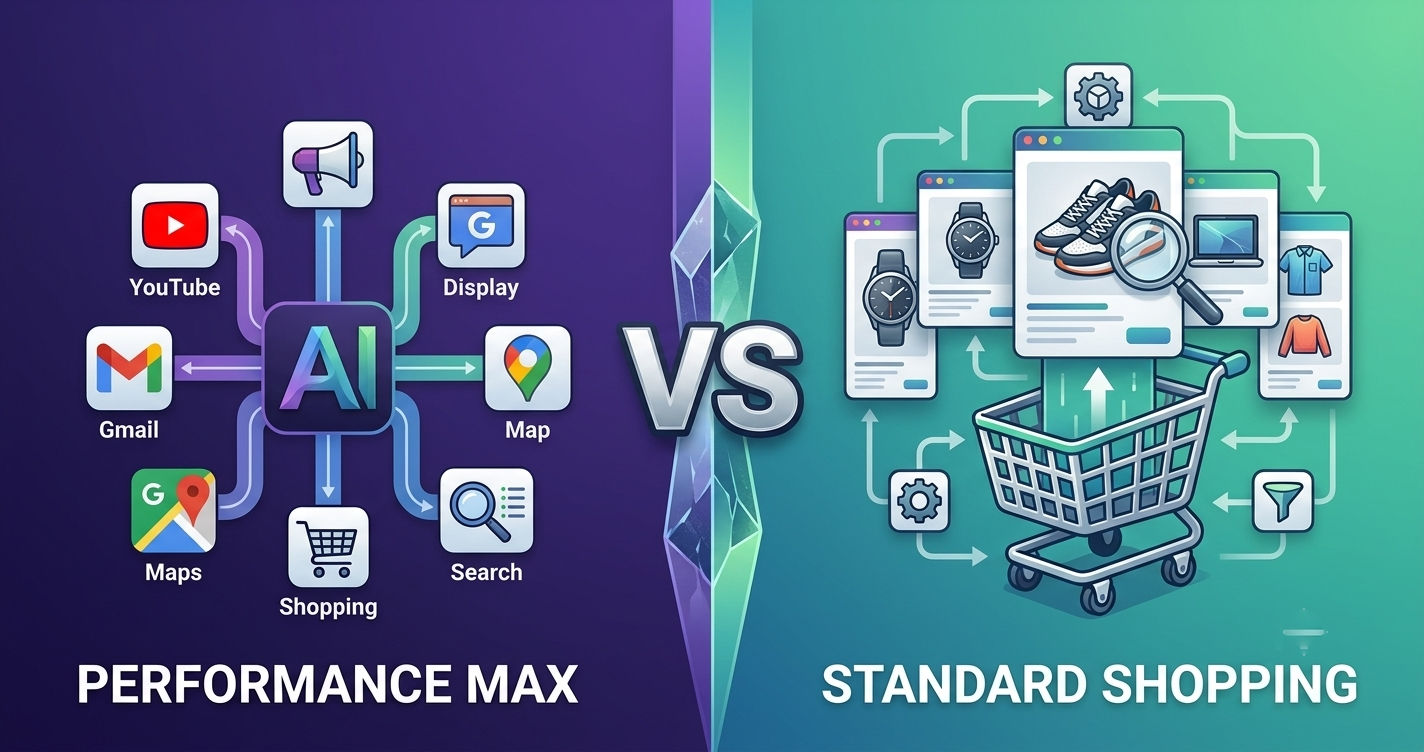
Google Ads remains a powerhouse for e-commerce brands, but choosing the right campaign type can make or break your profit margins. When comparing Performance Max vs Standard Shopping, you are looking at two completely different philosophies. One relies on total automation to chase conversions, while the other gives you absolute manual control over your ad spend.
Both campaign types use your Google Merchant Center product feed, but they handle your budget, placements, and targeting differently. Finding the right fit depends on your business goals, your creative resources, and how much control you want to maintain over your budget.
The Core Differences: Control vs. Automation
To make the right choice, you need to understand how each campaign operates behind the scenes.
What is Standard Shopping?
Standard Shopping is the traditional way to advertise products on Google. It is a structured, feed-driven system where you manage the bidding strategies, product groups, and negative keywords. Your ads look like standard product cards displaying an image, title, price, and store name. If you love digging into data and tweaking settings manually, this setup is built for you.
What is Performance Max?
Performance Max (often called PMax) is an all-in-one, fully automated campaign type. Instead of sticking to one or two areas, PMax uses machine learning to find buyers across all of Google’s networks. It does not just use your product feed. It also requires you to upload headlines, descriptions, images, and videos. Google’s AI mixes and matches these assets to find the highest-converting combinations.
Performance Max vs Standard Shopping: Head-to-Head Comparison
The major differences between these two options come down to where your ads show up, how you target shoppers, and what kind of data you can see in your reports.
| Feature | Performance Max | Standard Shopping |
| Ad Placements | Search, Shopping, YouTube, Display, Discover, Gmail, Maps | Google Search results and the Shopping tab |
| Automation Level | Fully automated bidding, targeting, and placements | High manual control over bids and structure |
| Creative Assets | Requires headlines, descriptions, images, and videos | Pulls data purely from your product feed |
| Keyword Control | No direct keyword bidding; limited negative keywords | Full access to negative keywords and query filtering |
| Reporting Transparency | Hidden channel spend and limited search term data | Detailed search term and product-level reports |
| Primary Goal | Scaling quickly across the entire funnel | Granular optimization and budget efficiency |
Where Your Ads Appear and How They Target Buyers
Where your ads land on the internet changes your audience’s intent. Standard Shopping sticks strictly to the Google Search page and the Shopping tab. This means you catch shoppers right when they are actively looking to buy a specific item. It is a great way to target bottom-of-funnel traffic with high intent.
Performance Max takes a full-funnel approach by spreading your ads across the entire Google ecosystem. Your products will appear on YouTube (including Shorts), the Google Display Network, Gmail, Maps, and the Discover feed. PMax uses predictive modeling and past customer behavior to show ads to people who might not even be searching for your product yet, which helps you build brand awareness while driving sales.
Frequently Asked Questions (FAQs)
Can I run Performance Max and Standard Shopping campaigns together?
Yes, you can run a hybrid strategy. Many retail brands use Performance Max to scale their reach across YouTube and Display, while keeping Standard Shopping active for high-priority search terms. Just watch your data closely to ensure PMax does not completely steal traffic from your manual campaigns.
Do I need video assets to use Performance Max?
Yes, creative assets are highly recommended. If you do not provide a video, Google will automatically generate a low-quality slideshow video from your uploaded images. To protect your brand image, it is always best to upload your own clean, high-quality video clips.
Why do some advertisers prefer Standard Shopping over Performance Max?
The biggest reason is transparency. Standard Shopping gives you a clear search terms report, showing exactly what words people typed before clicking your ad. Performance Max hides a lot of this data, making it harder to diagnose why performance dropped or where your budget went.
Is Performance Max good for a brand-new Google Ads account?
Performance Max can work for beginners because it handles the heavy lifting through automation. However, AI requires clean conversion data to learn effectively. If your website has zero sales history, starting with Standard Shopping can help you gather clean search data first.