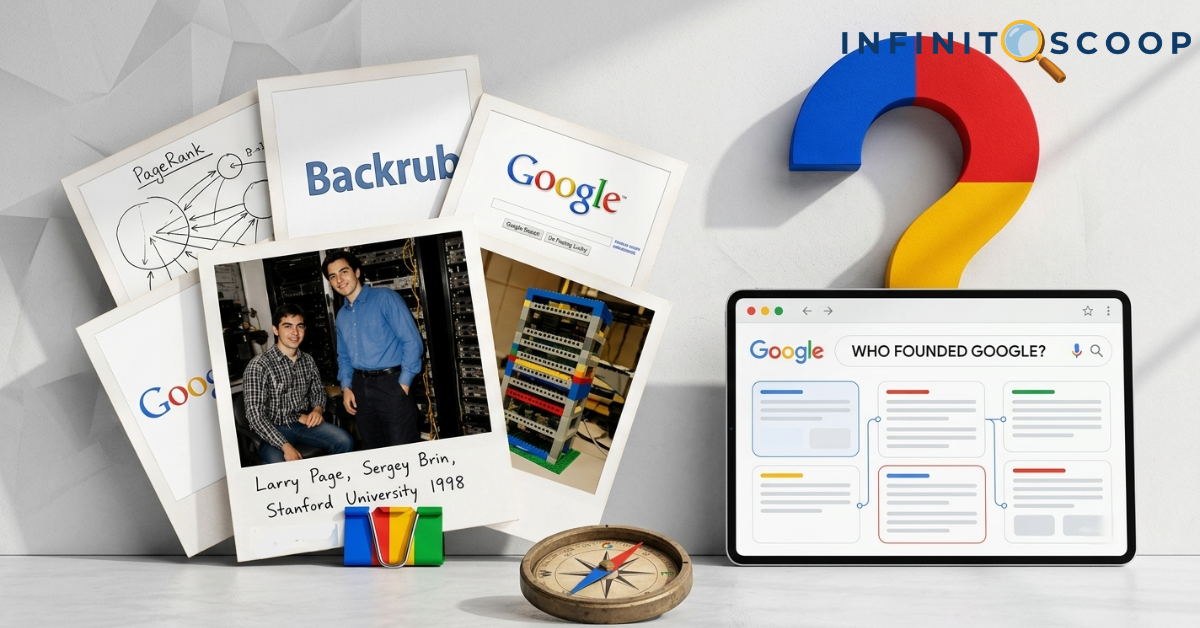
Two PhD students. One research project. And a massive question nobody had answered yet: which web pages actually matter?
That simple question is where Google began. Larry Page and Sergey Brin did not set out to build a multi-trillion-dollar empire. They just wanted to solve a frustrating digital problem. Understanding the history of Google means looking at how these two minds teamed up to organize a chaotic early internet when every other search engine was failing.
Google Company Facts at a Glance
Before looking at the history, here is a quick snapshot of Google’s foundational details and where the company stands today.
| Detail | Information |
| Founded | September 4, 1998 |
| Google Founders | Larry Page, Sergey Brin |
| Location | Menlo Park, California |
| Original Name | BackRub |
| Domain Registered | September 15, 1997 |
| Original Mission | “To organize the world’s information and make it universally accessible and useful.” |
| First Investor | Andy Bechtolsheim ($100,000) |
| IPO Date | August 19, 2004 (Nasdaq, $85/share) |
| Parent Company | Alphabet Inc. (since 2015) |
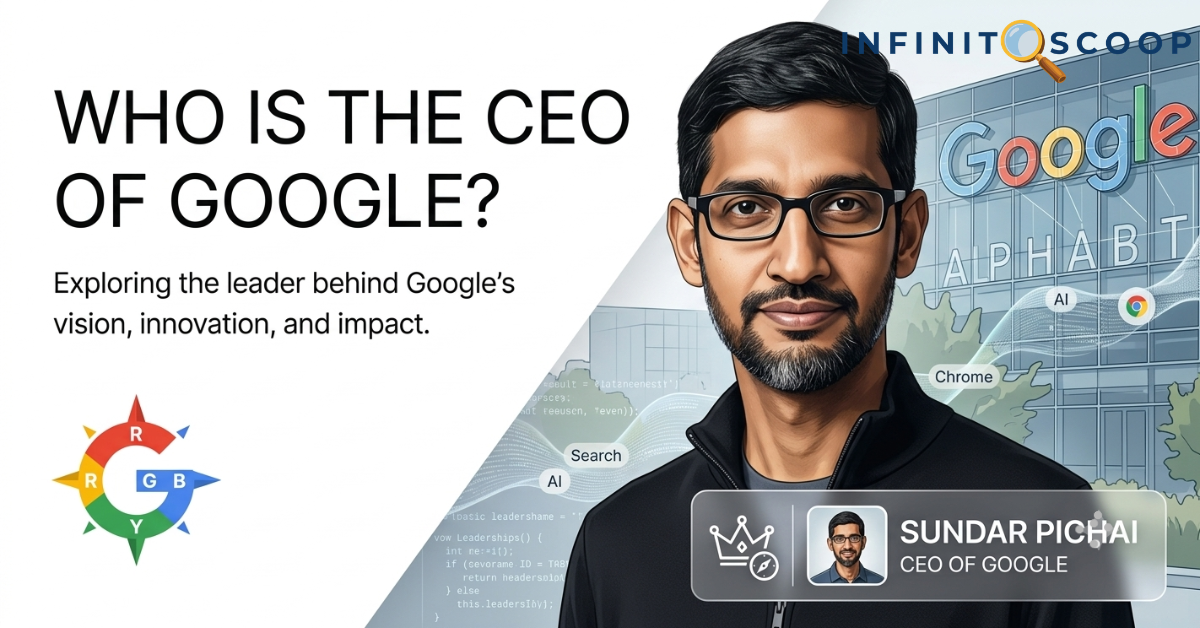
| Current CEO | Sundar Pichai |
Larry Page: The Architect of PageRank
Lawrence Edward Page was born on March 26, 1973, in East Lansing, Michigan. Growing up with a computer science professor and AI research pioneer for a father, technology was a natural part of his childhood. He earned his computer engineering degree from the University of Michigan in 1995 before heading to Stanford University for his PhD.
At Stanford, Page grew fascinated by the mathematical layout of the World Wide Web. He wondered how to prove which web pages were truly important based on how they linked to each other. His dissertation supervisor loved the idea and encouraged him to pursue it. Page later called that the best advice he ever received.
That academic pursuit turned into BackRub, which quickly evolved into Google. Today, Page is one of the wealthiest people on earth, with a net worth hovering around $269 billion to $281 billion. While he stepped down as Alphabet’s CEO in December 2019, he still keeps a seat on the board and controls 27.4% of the company’s total voting power.
Sergey Brin: The Data Mining Pioneer
Sergey Mikhailovich Brin was born in Moscow, Russia, in 1973. His family immigrated to the United States when he was six years old, eventually settling in Maryland. Just like Page, Brin grew up in an academic home with a father who worked as a mathematics professor.
Brin flew through his math and computer science degree at the University of Maryland, graduating with top honors in just three years. He landed at Stanford on a National Science Foundation fellowship, which set him on a direct collision course with Larry Page.
While Page focused on web architecture and link structures, Brin brought an elite skill set in data mining. He excelled at extracting clear patterns from massive, messy datasets. This exact combination of architectural vision and data mastery created the perfect foundation for a revolutionary search engine. Brin stepped away from his executive role in late 2019 but still holds 25.3% of Alphabet’s voting power, keeping ultimate control alongside Page.
How the Founders Met: A Disastrous First Impression
In 1995, Larry Page visited Stanford to see if he wanted to join their PhD program. Sergey Brin was already enrolled there and got stuck with the job of showing the newcomer around campus.
During that first tour, the two disagreed about absolutely everything. Page thought Brin was incredibly argumentative, while Brin found Page way too opinionated. It did not look like the start of a legendary tech partnership.
However, they kept talking over the next few months. They quickly realized their intense debates were highly productive. By 1996, they officially partnered up on the research project that would change the internet forever.
From BackRub to Google: The Tech That Changed the Web
In 1996, Page kicked off a university research project called BackRub. The name was a literal nod to what the system did: it analyzed “backlinks” to figure out how relevant and important a web page was.
[Web Page A] --(High Authority Link)--> [Web Page B (Ranked Higher)]
Page borrowed this logic from academic publishing. If a research paper is cited by hundreds of other scientists, it is clearly important. He applied that same rule to the web. If a page gets links from high-quality websites, it deserves to rank higher.
This breakthrough became the PageRank algorithm, named after Larry Page himself. Brin jumped in to help develop the math, and their joint research paper became a cornerstone of internet history. Soon, BackRub used up so much of Stanford’s internet bandwidth that university leaders had to intervene.
By 1997, the duo registered the domain google.com. The name is a play on “googol,” the math term for a 1 followed by 100 zeros. They chose it to mirror their goal of organizing a seemingly infinite universe of digital data.
The $100,000 Parking Lot Check and Susan’s Garage
On September 4, 1998, Page and Brin officially incorporated Google Inc. as a private company in California. Getting the funding to make that happen required a bit of Silicon Valley luck.
Andy Bechtolsheim, a co-founder of Sun Microsystems, caught a quick demo of the search engine. He loved it immediately. He whipped out a checkbook, wrote a $100,000 check made out to “Google Inc.,” and rushed off to his next meeting. The only issue? Google Inc. did not legally exist yet. Page and Brin had to hold onto the funds for two weeks until they finished incorporating the business just to deposit it.
With money in hand, they rented a garage in Menlo Park, California, from Susan Wojcicki for $1,700 a month. Wojcicki became one of Google’s first employees and eventually rose to become the CEO of YouTube. That garage is now an official California historic landmark.
Why Google Destroyed Early Competitors
When Google entered the scene, platforms like Yahoo, AltaVista, and Lycos already owned the market. Yet, Google made them irrelevant in just a few short years. Here is how they did it:
- Unbeatable Results: The PageRank system could not be fooled by hidden keywords, which made Google’s search results far cleaner than anyone else’s.
- Radical Simplicity: While Yahoo packed its homepage with messy news portals and ads, Google offered a blank white page with a single search box.
- Blazing Speed: In the days of slow dial-up internet, Google focused entirely on serving links in milliseconds.
- Smart Infrastructure: Instead of buying expensive, specialized mainframe tech, Google strung together thousands of cheap, regular computers to handle data at scale.
Google barely spent a dime on marketing during its early days. The product was so much better than the competition that it spread completely through word of mouth.
Google by the Numbers: 2026 Dominance
Decades after its garage days, Google remains the unchallenged king of the internet. Here is where the data stands today:
- Global Search Market Share: ~90% across all devices
- Daily Search Volume: Over 14 billion requests
- Annual Search Volume: Over 5 trillion requests
- Global Website Rank: google.com is #1 worldwide
- YouTube Active Users: Over 2.7 billion monthly users
- Chrome Browser Share: ~65% of the global market
- Alphabet Annual Revenue: ~$422 billion
Legal Wars and Antitrust Challenges
Google’s absolute dominance has landed the company in hot water with global regulators. The business faces massive scrutiny over how it protects its crown.
In August 2024, a U.S. federal court officially ruled that Google operated an illegal monopoly in general search. The judge found that Google paid billions of dollars to smartphone makers and browsers to guarantee its spot as the default search engine. By September 2025, courts banned these exclusive contracts and ordered Google to share data with rivals.
A separate 2025 ruling targeted Google’s advertising business, finding it monopolized digital ad exchanges. Combined with ongoing privacy fights in the US, UK, and EU, these antitrust legal battles continue to stretch deep into 2026.
Where Are Larry Page and Sergey Brin Today?
Google’s 2004 Wall Street debut turned both founders into instant billionaires. They famously cut their corporate salaries to a symbolic $1 per year, keeping their wealth tied entirely to company shares.
Page returned for a stint as Google’s CEO in 2011, and transitioned to Alphabet CEO when the parent company formed in 2015. Brin served right alongside him as Alphabet’s President. In December 2019, they handed daily control over to current CEO Sundar Pichai. Though they stay out of the daily spotlight, their private Class B shares give them an ironclad 52.7% voting majority, meaning they still hold final say over the entire Google empire.
Frequently Asked Questions (FAQs)
Who founded Google and when did it start?
Google was officially founded by Stanford PhD students Larry Page and Sergey Brin on September 4, 1998, following two years of intense research on university servers.
Where exactly was Google first created?
The company started inside a rented garage in Menlo Park, California, owned by Susan Wojcicki. Google eventually moved its headquarters to its current campus in Mountain View, California.
What is the meaning behind the name Google?
The name is a playful spelling of “googol,” which represents the number 1 followed by 100 zeros. The founders picked it to show their goal of organizing massive amounts of online information.
Why did Google succeed while other early search engines failed?
Google relied on its unique PageRank algorithm, which ranked sites based on link authority rather than just counting keyword text. This approach delivered far better search results on a lightning-fast, ad-free homepage.