SpaceX stands tall as the most valuable private company on the planet. From launching massive rockets to powering global internet through its Starlink satellite network, its reach is undeniable. The company even made waves recently by joining forces with Elon Musk’s artificial intelligence venture, xAI.
Yet, you won’t find SpaceX on the New York Stock Exchange or Nasdaq. Because it remains private, many wonder who actually holds the keys to this aerospace giant.
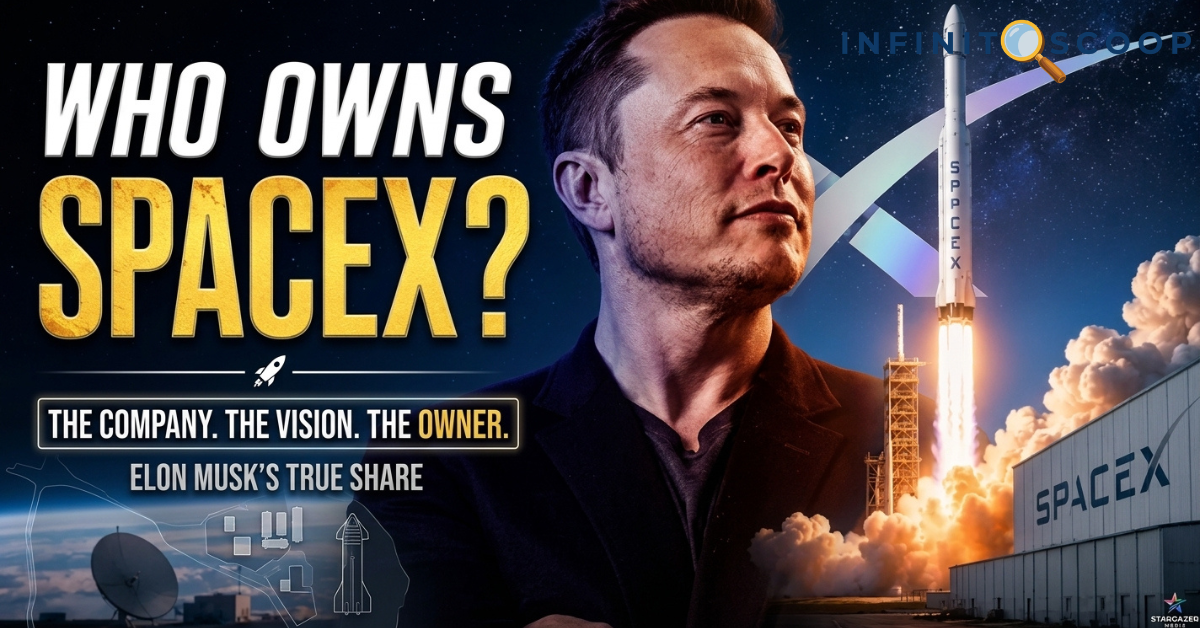
The short answer is Elon Musk. As the founder and CEO, he owns the biggest slice of the pie. While he holds about 42% of the actual equity, a special share structure gives him a massive 83.8% of the voting rights. This means he calls all the shots, even with major global funds and tech giants holding minority stakes.
The Spark: How SpaceX Started
Elon Musk built Space Exploration Technologies Corp—better known as SpaceX—from scratch on March 14, 2002. Fresh off selling his PayPal shares to eBay, he walked away with a massive fortune. He took $100 million of his own cash and risked it all on his new rocket venture, giving himself total ownership at the start.
His ultimate mission sounded like science fiction at the time: slash the cost of space travel and build a city on Mars. Most investors laughed it off in the early days. Because Musk funded the dream himself, he avoided selling off pieces of his company early on, which explains his absolute control today.
Now based out of Starbase, Texas, near the Gulf Coast, SpaceX has transformed the aerospace industry. The company employs over 14,000 people and launches more rockets into orbit per year than any single country on Earth.
Equity vs. Voting Power: The Dual-Class Secret
Owning a company’s stock and controlling its decisions are two different things. Musk owns roughly 42% to 43% of SpaceX’s equity. With the company valued at a staggering $1.25 trillion after its xAI merger, his personal stake is worth over $520 billion on paper.
However, the real power lies in his voting control. Thanks to a dual-class share setup, Musk holds supervoting shares that carry far more weight than standard stock. Confidential financial filings reveal that Musk commands 83.8% of all voting rights.
To put that into perspective, Mark Zuckerberg held about 58% of Facebook’s voting power during its 2012 public debut. Musk’s grip is much tighter. Even if every other single investor teamed up to vote against him, they couldn’t block his decisions.
The SpaceX Shareholder Breakdown
While Musk pulls the strings, top-tier venture firms, tech companies, and corporate partners hold valuable pieces of the business.
| Stakeholder | Equity Percentage | Voting Control |
| Elon Musk | 42.5% | 83.8% |
| Alphabet (Google) | ~7% | ~2-3% |
| Fidelity Investments | ~2% | <1% |
| EchoStar | Significant | <2% |
| Founders Fund | <2% | <1% |
| Sequoia Capital | <2% | <1% |
| Employees & Others | Rest of Balance | Minimal |
Meet the Other Major Investors
Over the years, SpaceX raised billions to fund its aggressive expansion, inviting elite backers into the fold.
Alphabet (Google)
Google’s parent company owns roughly 7% of SpaceX. They jumped in early during a 2015 funding round alongside Fidelity. That early bet paid off massively, turning a combined $1 billion investment into a position worth tens of billions today.
EchoStar
A new major player entered the mix recently. SpaceX struck a $17 billion deal to acquire EchoStar’s wireless spectrum. As part of the payment, EchoStar received $8.5 billion in SpaceX stock, making them one of the largest external shareholders.
Elite Venture Firms & Global Funds
Peter Thiel’s Founders Fund saved SpaceX in 2008 by investing right after three rocket launch failures. Other heavy hitters like Sequoia Capital and Andreessen Horowitz joined later rounds. Additionally, several prominent Middle Eastern sovereign wealth funds and tech giants like Nvidia gained stakes following recent funding loops and the xAI merger.
From Millions to Trillions: The Valuation Surge
The financial growth of SpaceX defies historical trends for private tech companies. Let’s look at how fast the company’s valuation skyrocketed over the last few years.
- January 2023: $137 billion
- Late 2023: $150–$210 billion
- December 2024: $350 billion
- February 2026 (Before Merger): $1.0 trillion
- Post-xAI Merger (Current): $1.25 trillion
- Expected IPO Target: $1.5 trillion
This astronomical value relies on two core engines. First is Starlink, which operates over 6,000 satellites and serves more than 4 million global users. Second is Starship, the fully reusable mega-rocket designed to carry NASA astronauts back to the moon.
Can Everyday Investors Buy SpaceX Stock?
Right now, everyday retail investors cannot buy direct shares of SpaceX. Because it is a private company, you won’t find it inside your standard brokerage app.
Avenue options remain highly restricted. Wealthy, accredited investors can sometimes buy shares from early employees via private secondary platforms like EquityZen or Forge Global. For average investors, the only current option is indirect exposure by buying Alphabet stock, given their 7% stake in the rocket company.
However, Wall Street is buzzing with rumors of a mid-2026 initial public offering (IPO). If the company decides to go public, it could open up a historic $1.5 trillion market opportunity for everyday stock traders.
Frequently Asked Questions (FAQs)
Does Tesla own SpaceX?
No, Tesla and SpaceX are entirely separate companies with their own boards and independent finances. They only share a connection through Elon Musk, who serves as CEO for both. Tesla does hold an indirect financial interest through a recent $2 billion investment in xAI, which operates under the SpaceX umbrella.
How can I buy SpaceX stock before the IPO?
Only verified, accredited investors can access shares early through private secondary marketplaces like Forge Global. Average retail investors must wait for an official public listing or buy shares of Alphabet to get minor, indirect exposure.
Why does Elon Musk have so much power if he owns less than half the company?
SpaceX uses a dual-class share system. Musk owns specific “supervoting” shares that give him multiple votes per share, while outside investors receive standard shares. This setup ensures he retains 83.8% of the voting control despite owning 42.5% of the actual equity.
Is SpaceX worth more than NASA?
You cannot easily compare the two. NASA is a federally funded government agency with an annual budget of roughly $25 billion, meaning it has no market valuation. SpaceX is a private corporation valued at $1.25 trillion, though it heavily partners with NASA on space missions.